Telecom & Mobile Allowance Guide: What Companies Offer in 2026?

What is a telecom or mobile allowance?
A telecom or mobile allowance is a benefit provided to employees to cover their work-related mobile and telephone expenses. It may be in the form of a fixed allowance, actual reimbursement, or a monthly stipend.
Are you aware?
INOXCVA has a grade system of telephone allowance as follows:
|
Grade |
Mobile Allowance p.m. |
|
Grade 4 & above |
Actual reimbursement |
|
Grade 5–7 |
₹750 |
|
Grade 8 & below |
₹500 |
Why is this benefit relevant in 2026?
With a growing demand for work flexibility and a results-oriented work culture, telecom/mobile allowance has become critical to businesses. It maintains workflows and keeps everyone up to date in real time, which is pivotal for decision-making.
Do you know?
The Union budget of India in 2026 understood the importance and necessity of telecom expansion, increased its funding by 38%, and allotted around Rs 28,473 crores to BSNL.
What are the strategic benefits to employers of telephones and mobile allowances?
Today, smartphones are an extension of laptops and a workspace for many. It is a boon for flexible work arrangements and improves productivity. Moreover, it attracts/retains employees, especially in the IT sector, as it is critical to business.
What Types of Telecom & Mobile Allowances Do Companies Offer in 2026?
Today, there are four types of telecom and mobile allowances offered by corporates. Namely:
- Reimbursement for actual bills
- Corporate-owned device plan
- Fixed Monthly Stipend
- Bring Your Own Device (BYOD) Stipend
Which telecom and mobile allowances are most tax-efficient in India?
Reimbursement of the actual bill is the best telephone allowance exemption in India, as it is considered an expense and not a salary for employees.
Are you aware?
In a tribunal decision related to ITO, Bangalore v. M/s LG Soft India Pvt Ltd (Bangalore), it was held that telephone reimbursement, if submitted with proper documents and in accordance with Rule 3(7)(ix), will be treated as a non-taxable perquisite irrespective of the fact that the same is included in the salary structure of the employee.
Are mobile and Internet allowances taxable in India?
The law is crystal clear. If reimbursement is on actual bills submitted by employees, then it remains untaxable, i.e., you can avail yourself of a telephone allowance exemption. It is exempt under Rule 3(7)(ix) of the Income Tax Rules.
In all other cases, such as a fixed stipend or fixed allowance, it is added to the salary and taxed accordingly, i.e., no telephone allowance exemption.
Do you know?
Rule 3(7)(ix) of the Income Tax Rules deals with telephone and mobile reimbursements.
What is a Corporate-Owned Device (COD) Plan for Mobile?
A corporate-owned device plan is a mobile strategy where employers purchase, manage, and issue mobile phones to employees for business purposes.
Are you aware?
A research paper talked about the management of mobile devices and security concerns and concluded that robust management frameworks are essential for maintaining regulatory compliance and mitigating risks associated with them. Moreover, it was found that mobile device management improved efficiency and security for both employees and employers. APA Style: Mohiuddin, K. T. (2023). Mobile Device Management and Its Security Concerns. International Research Journal of Engineering and Technology (IRJET), 10(10).
https://www.academia.edu/109348192/Mobile_Device_Management_and_Their_Security_Concerns
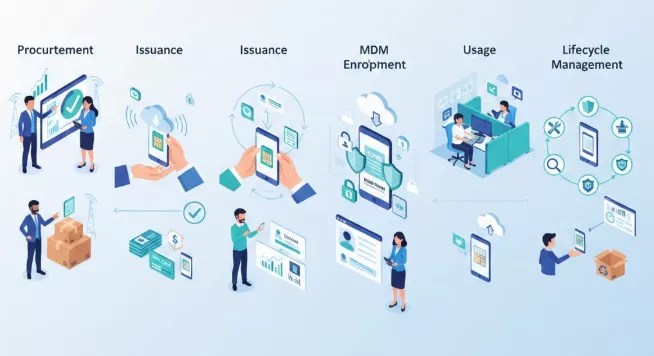
The process flow of the Corporate-Owned Device plan is as follows:
When Should a Company Choose a Corporate-Owned Device (COD) Plan?
A company should consider a corporate-owned device plan for employees in leadership, senior management, sales teams, and roles that involve handling sensitive and confidential data, as well as for clients.
What Are the Challenges of COD Plans?
Higher procurement costs and balancing employee privacy and security controls are the most pivotal challenges of COD plans.
What Is a Fixed Monthly Stipend Telephone Allowance?
As the name suggests, a fixed monthly stipend telephone allowance is a fixed amount paid to employees for mobile expenses. No bills or invoices are submitted, and the allowance is included in the salary.
Why Do Companies Offer Fixed Telephone Stipends?
Companies offer fixed telephone stipends to maintain consistency throughout the company, to predict the overall costs, and to simplify administration.
How do fixed telephone stipends differ from reimbursement-based telephone allowances?
The difference is in tax treatment and documentation.
|
Component |
Requires Bills/Proof? |
Tax Treatment (India) |
|
Fixed Monthly Stipend Telephone Allowance |
No |
Taxable as salary |
|
Billing-Based Reimbursement |
Yes |
Tax-exempt if official under Rule 3(7)(ix) |
What Is a Bring Your Own Device (BYOD) Stipend?
BYOD Stipend is a fixed monthly allowance for employees to use their personal devices for official purposes.
Why Do Companies Offer a BYOD Stipend?
Companies offer BYOD stipends as they are hassle-free and adaptable to flexible work arrangements, with no capital expenditure.
Is a BYOD Stipend Taxable in India?
Yes, if not supported by an invoice/bill under Rule 3(7)(ix) of the Income Tax Act, 1961.
What Is Phone Reimbursement for Employees in India, and How Does It Work?
Any expense reimbursed by employers for telephone or internet bills used for official purposes is known as phone reimbursement.
Practical Implementation: Key Steps
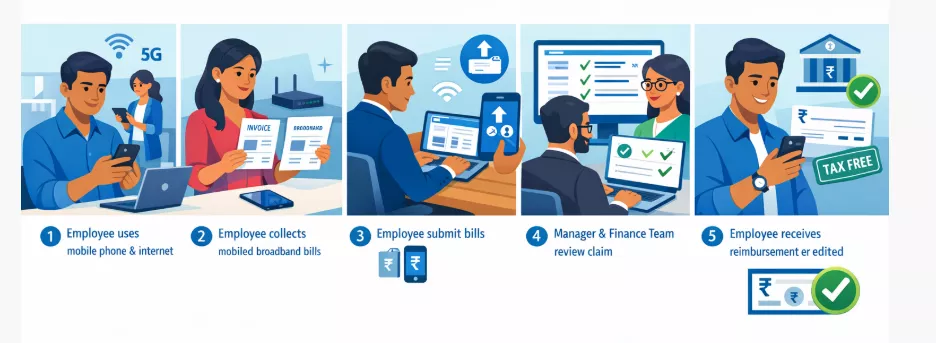
Step 1: The employee utilises the net or mobile connection in their name.
Step 2: The bill is collected for the specific period.
Step 3: The bill/invoice is submitted in the portal.
Step 4: The bill/invoice is reviewed, and the claim is approved.
Step 5: Employees received reimbursement.
How should companies structure phone reimbursement policies?
Strong eligibility criteria, along with fair and clear reimbursement rules and a standard procedure for approvals and timelines, can help companies structure tiered policies.
In India, how can companies reimburse employee phone bills legally?
Two important criteria to legally reimburse are
- Utilisation for business purposes
- Valid invoices/bills.
What Conditions are a Must for Legal Reimbursement?
To ensure legal and tax compliance for reimbursement, the following conditions must be met.
- Reimbursement should be against an actual bill/invoice.
- The bills must be in the name of the employees.
- The expense is in the course of business.
- Invoices/ bills for documentation.
- An HR policy must be in place for such reimbursements.
How does Pluxee support telecom and mobile expenses?
Pluxee supports telecom and mobile expenses by providing digital solutions for reimbursement and direct payment, allowing employees to use dedicated funds for mobile bills, broadband, and Wi-Fi, managed via the Pluxee app, where they can upload bills or use their card at RuPay merchants for seamless, tax-efficient connectivity solutions for remote/hybrid work.
FAQ
1. Is there a financial limit on reimbursement?
No, but it needs to be reasonable and should align with company policy.
2. Can both prepaid and postpaid plans be reimbursed?
Yes, if supported by valid bills and invoices.
3. What documentation must an employee submit?
The documents below need to be submitted to claim reimbursement.
- Original bills/invoices
- Expense claim form via HR portal submission of claim
- Approval from the reporting manager, and
- Self-declaration that the expenses were for business purposes.
4. Does the phone connection have to be in the employee’s name?
Yes, bills/invoices should be in the name of the employee to qualify for a non-taxable refund.
5. Is reimbursed salary for phone bills taxable?
No. Under Rule 3(7)(ix) of the Income Tax Rules, phone expenses incurred for official work are reimbursed based on an invoice/phone bill, which is non-taxable in both the old and new regimes of income tax.
6. Why is it non-taxable?
It is non-taxable, as it represents business expenses. It is reflected as any other expense incurred for running the business.


Related articles