How to Build an Employee Recognition Program: Guide for Indian HR Teams

What is an Employee Recognition Program?
An employee retention plan is a strategic HR policy designed to appreciate, value, and reward employees. It celebrates employees’ milestones, achievements, and extraordinary accomplishments.
What is an Employee Recognition Program?
An employee retention plan is a strategic HR policy designed to appreciate, value, and reward employees. It celebrates employees’ milestones, achievements, and extraordinary accomplishments.
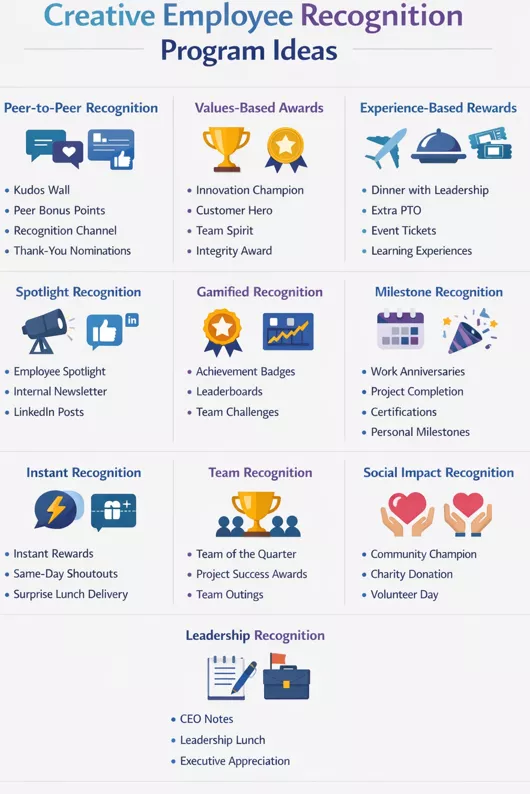
Types of recognition programs
- Peer-to-peer recognition
- Manager recognition (Leadership recognition)
- Performance awards (team recognition)
- Milestone recognition (work anniversaries)
- Instant recognition (Spot awards)
- Innovation awards (social impact recognition)
- Values-based recognition
- Experience-based recognition
- Spotlight recognition
- Gamified recognition
Are you aware?
Quantum Workspace reported that employees are 2.7x more likely to be engaged when recognition is expected.
Can you suggest creative employee recognition program ideas for small and large companies?
Yes, there are some creative employee recognition program ideas for small and large companies. Let’s discuss them.
Do you know?
Reports published in Reward Point stated 79% of employees report feeling undervalued at work despite investments in recognition programs. This gap can be filled by creative employee recognition program ideas.
What are creative employee recognition program ideas for small companies?
Small companies often have limited budgets but greater variation for personalised recognition.
Are you aware?
According to Flair HR, 65% of employees prefer personalised, non-cash rewards.
-
Founder’s Appreciation Award
It is a monthly award for an achiever, especially given by the founder. It builds loyalty and uplifts morale.
-
Skill development recognition
Skill development recognition rewards employees with sponsored certifications, conference tickets, and online certification courses.
-
Peer-to-Peer Recognition Wall
In this program, employees nominate colleagues for collaboration, leadership, or out-of-the-box thinking.
-
Employee Appreciation Day
On employee appreciation day, organizations invite employees’ families to a public event. It is very effective in Indian culture, where family support influences job satisfaction.
What are creative employee recognition program ideas for large companies?
Large companies often look for a more structured, value-driven, and scalable recognition program.
-
AI-Powered Recognition Platforms
Large enterprises look for AI-powered recognition platforms to integrate with HR analytics. It includes peer recognition, instant digital badges, and a performance dashboard.
-
Innovation Impact Awards
The Innovation Impact Awards recognize employees who create an impact in the organization.
-
Cultural Ambassador Program
Recognition of employees who embody the organization's culture and present an example for others to follow is the base of the cultural ambassador program.
-
Micro-Recognition Programs
Short, periodic recognition programs such as spot bonuses and shoutouts during team meetings fall under micro-recognition programs.
-
Why Do Indian Companies Need a Recognition Program?
A transparent and fair recognition program builds trust, sets organisational culture, and enhances employee engagement, productivity, and retention. It creates brand power irresistible to the workforce.
Are you aware?
According to Wifitalents, 80% of employees say they work harder if they feel recognised.
How do rewards and recognition programs improve employee engagement?
Psychological satisfaction is the core goal of any rewards and recognition program that intuitively improves employee engagement. When employees feel valued, they become emotionally connected and contribute more willingly.
Practically, engaged employees,
- Show higher commitment.
- Demonstrate stronger collaboration.
- Align better with company goals.
Do you know?
According to Forbes, employees who believe recognition is part of their company culture are 3.7 times more likely to be engaged and less likely to experience burnout. It also strengthens the workplace community, making employees eight times more likely to feel they belong in the organisation.
How do rewards and recognition programs increase productivity?
Recognition enhances productivity by motivating employees and creating healthy competition within teams. It enhances the quality of work and encourages the workforce to evolve.
What are the pivotal business benefits of employee recognition?
A well-designed recognition program produces measurable results such as
Lower employee turnover
Companies with a deeply ingrained recognition culture report lower turnover and higher retention.
Stronger company culture
Employee recognition sets the tone of an employee-first culture in the organization.
Higher employee engagement
Employees who receive recognition regularly are more engaged than those who do not.
Better employer branding
Employees are an organization's first brand ambassadors, and a well-constructed recognition program can uplift an employer’s brand in the industry.
How do you create an employee recognition program from scratch?
Below is the step-by-step framework used by performing organisations.
Do you know?
RewardPort published that employee engagement is enhanced by three times just by structuring rewards and recognition programs.
Step 1: Identify and define the objective.
Typical goals include retention, performance management, and employee engagement. Organisations must start by answering the following:
- What behaviours do we want to reinforce?
- What cultural values should recognition support?
- What business outcomes are expected?
Step 2: Align Recognition With Company Values
Recognition programs should align with company values and leadership principles. The examples are:
| Value | Recognition Behaviour |
| Customer obsession | : Solving a major customer issue |
| Innovation | : New product idea |
| Collaboration | :Cross-team success |
This ensures recognition reinforces culture, not just performance.
Step 3: Define recognition categories.
A balanced recognition program is well equipped with multiple awards, such as:
- Instant recognition—spot rewards
- Monthly Awards—Best performer of the month
- Quarterly Recognition - Leadership awards or innovation recognition.
- Annual Awards - Top performers and culture champions.
Step 4: Introduce Peer-to-Peer recognition
Peer recognition delivers respect and acceptance among team members. Common peer recognition models include appreciation walls, slack recognition channels, and internal recognition apps.
Step 5: Use of innovative programs.
Modern recognition programs use innovations that are AI-led and include digital badges, reward points, leaderboards, and analytics dashboards to scale. Many a time, a personalised combination works best to engage employees.
Are you aware?
A journal published by the Asian Journal of Management and Commerce in 2025 stated that companies without AI-driven systems generally have lower fairness ratings, highlighting that technological integration is a significant competitive advantage for modern HR practices. Gangwani, S., & Gangwani, M. (2025). Comprehensive analysis of Infosys employee recognition & reward programs. Asian Journal of Management and Commerce, 6(2), 1289-1295. https://www.allcommercejournal.com/article/855/6-2-258-975.pdf?utm_source
Step 6: Training managers to recognise employees.
One of the biggest failures of recognition programs is low participation. Moreover, recognition is sometimes a cyclic movement between employees. Hence, training managers is very important.
Best practices include:
- Recognition training of employees
- Monthly reminders
- Recognition goals in leadership KPIs.
Step 7: Results tracking and improvements
Key metrics commonly used to track the outcomes of rewards and recognition programs include employee turnover rates, engagement rates, and productivity metrics.
What are the best practices for designing an effective employee recognition program?
The core best practices for designing an effective employee recognition program are:
- Aligning recognition with the company's values.
- Frequent and timely recognition.
- Fair and transparent recognition programs.
- Personalised awards.
- A combination of monetary and nonmonetary awards.
- Focus on peer-to-peer recognition.
What is the future of employee recognition?
Artificial intelligence, along with analytics and digital collaboration platforms, is evolving recognition programs. The key trends include:
- Customised awards.
- Recognition embedded with work tools.
- Behaviour-based recognition analytics.
- AI-powered recognition insights.
What types of recognition programs work best in the Indian corporate culture?
Recognition programs aligned with Indian cultural values perform better.
| Recognition Type: | Why it Works |
| Public recognition: | Strong social validation |
| Family-inclusive awards: | Cultural importance of family |
| Leadership recognition: | Respect for hierarchy |
| Skill development rewards: | Career growth priority |
| Community service awards: | Social responsibility |
What mistakes should companies avoid in recognition programs?
Organisations that avoid the following mistakes achieve better results in recognition programs:
- Recognition only for managers.
- Annual recognition instead of instant and frequent recognition.
- Preference for generic rewards over personalised ones.
- Ignoring behavioural achievements.
- Monetary rewards without emotional recognition.
Do you know?
RewardPoint reported that 79% of Indian employees feel undervalued, indicating ample scope for improvement in recognition programs.
What are some successful employee recognition program examples used by top companies?
Some successful employee recognition program examples are as follows:
|
Company |
Program Name / Type |
Key Features |
Impact / Outcome |
Source |
|
Infosys |
InfyGold+ Program |
Personalized rewards, AI-driven recognition, partner ecosystem |
Improves engagement, retention, and productivity |
https://www.allcommercejournal.com/article/855/6-2-258-975.pdf (allcommercejournal.com) |
|
Tata Group |
Energize Program |
Monetary + non-monetary rewards, public appreciation, career growth |
Strengthens engagement and recognition culture |
https://www.inspirajournals.com/uploads/Issues/1023364676.pdf (INSPIRA) |
|
SAP Labs India |
Spotlight Recognition Program |
Instant recognition, peer + manager appreciation, visible on intranet |
Boosts morale and cross-functional collaboration |
https://www.ijltemas.in/submission/index.php/online/article/download/2565/2633/9010 (IJLTEMAS) |
|
Netflix |
Freedom & Responsibility Culture |
Unlimited leave, autonomy-based recognition |
Drives innovation and high performance culture |
https://www.linkedin.com/pulse/corporate-culture-venkat-r-venkitachalam-42lrf (LinkedIn) |
Which company offers the best employee recognition programs?
Pluxee offers digital-first employee recognition programs and reward solutions designed to boost engagement, morale, and retention. Through their platform, employers can provide both tangible rewards (gift cards and meal cards) and intangible recognition (peer-to-peer shout-outs) to create a culture of appreciation and enhance productivity.
https://www.pluxee.in/blog/employee-recognition-programs-building-a-culture-of-appreciation/


Related articles