Corporate Wellness Programs in India: Types, Benefits & Real Examples

What Are Corporate Wellness Programs?
Corporate wellness programs are strategies designed and led by employers to enhance the mental, physical, social, and emotional well-being of employees.
Why are corporate wellness programs important for Indian companies today?
In recent times, corporate wellness programs have become an absolute essential because
- It impacts efficacy, decision-making, and retention.
- It reduces healthcare costs and workplace absenteeism.
- It improves productivity and engagement.
- It attracts and retains top performers.
Do you know?
Fortune India reported that presenteeism (working while sick) and chronic illnesses can cost Indian companies up to ₹1.12 lakh per employee annually.
What Are the Main Types of Corporate Wellness Programs?
Wellness programs fall under four major categories. They are physical, mental, lifestyle, nutrition, and work-life balance.
|
Type of Program |
Focus Area |
Typical Activities |
|
Physical Wellness |
Fitness & preventive health |
Health screenings, gym subsidies, yoga classes |
|
Mental Wellness |
Emotional resilience |
Counselling, stress management, mindfulness |
|
Lifestyle & Nutrition |
Disease prevention |
Nutrition workshops, diet planning |
|
Work-Life Balance |
Holistic life support |
Flexible hours, break rituals, and Burnout prevention |
What are the best workplace wellness programs?
The best workplace wellness programs, as per their type, are as follows:
Physical Wellness Program
Physical wellness programs, such as onsite/online fitness sessions, corporate gym partnerships, and ergonomic workplace setups, reduce medical costs, decrease absenteeism, and inculcate a positive work culture.
What are the best practices in physical wellness programs in India?
In India, the best practices in physical wellness programs are
- Incorporating health screening annually
- Including digital fitness & wellness subscription and
- Encouraging employees with incentives or rewards
Mental Wellness Programs
Today, awareness related to mental well-being has increased, and many corporations and celebrities have openly discussed it on public platforms.
What are the best mental health benefits employers should provide in 2026?
Corporations can include the following programs to improve mental well-being in employees:
- Therapy & psychologist access
- Stress management sessions
- Burnout prevention programs
- Adding paid mental health leave to casual leave
What can companies do to support mental well-being in employees?
Indian corporations can do the following to support employees:
- Partner with licensed mental health organisations.
- Ensure confidentiality and remove stigma.
- Train managers in empathy and emotional intelligence and
- Add periodic wellness check-ins
Do you know?
Accenture India provides free counseling sessions, mental health helplines, and digital well-being tools for employees and their families.
Lifestyle and Nutrition
Lifestyle and nutrition wellness programs emphasise building focus and immunity.
It includes:
- Nutrition coaching
- Healthy cafeteria options
- Corporate diet plans
- Hydration & wellness campaigns
How can corporates implement lifestyle and nutrition wellness programs?
Corporations can introduce healthy meal vendors, launch nutritional webinars, and conduct awareness programs to initiate lifestyle and nutritional wellness programs.
Work-life balance programs
After COVID, these programs are on the wishlist of new joiners. They want to remain close to their family and work as per their convenience. Moreover, any imbalance leads to burnout and attrition. Organisations are now offering hybrid work options, flexible hours, and a reduced overtime culture in their wellness policy to retain employees and reduce exhaustion and stress.
Can you suggest some ways to implement work-life wellness programs?
Yes, some of the best ways to implement work-life wellness programs are
- Define a clear hybrid policy.
- Respect boundaries (avoid “always-on” culture)
- Promote leave utilisation
- Train leaders to model balance
Are you aware?
Infosys initiated HALE (Health Assessment & Lifestyle Enrichment), which included annual health assessments, fitness activities, mindful workshops, and nutrition education to reduce lifestyle risks among employees.
What Benefits Do Companies See from Wellness Programs?
Enhanced retention rates, improved employee engagement, and better decision-making are some of the benefits organisations have achieved by introducing wellness programs.
How Do Wellness Programs Impact ROI (Return on Investment)?
Harvard Business Review conducted research and found that the ROI of wellness programs can be as high as six times, measured by cost savings and productivity gains.
Berry, Leonard & Mirabito, Ann & Baun, William. (2010). What’s the Hard Return on Employee Wellness Programs?. Harvard business review. 88. 104-12, 142.https://www.researchgate.net/publication/49712304_What's_the_Hard_Return_on_Employee_Wellness_Programs
What Practical Steps Should Companies Take to Build an Effective Wellness Program?
Are you aware?
A study conducted to understand the implementation and effectiveness of employee wellness programs in the IT sector revealed that program monitoring was inadequate, and it concluded that these programs must be part of the organization's core strategy. Sreenath, Sumithra. (2019). Employee Benefits and its Effect on Productivity at Semcon India Private Limited, Bangalore. SDMIMD Journal of Management. https://doi.org/10.18311/SDMIMD/2019/23126
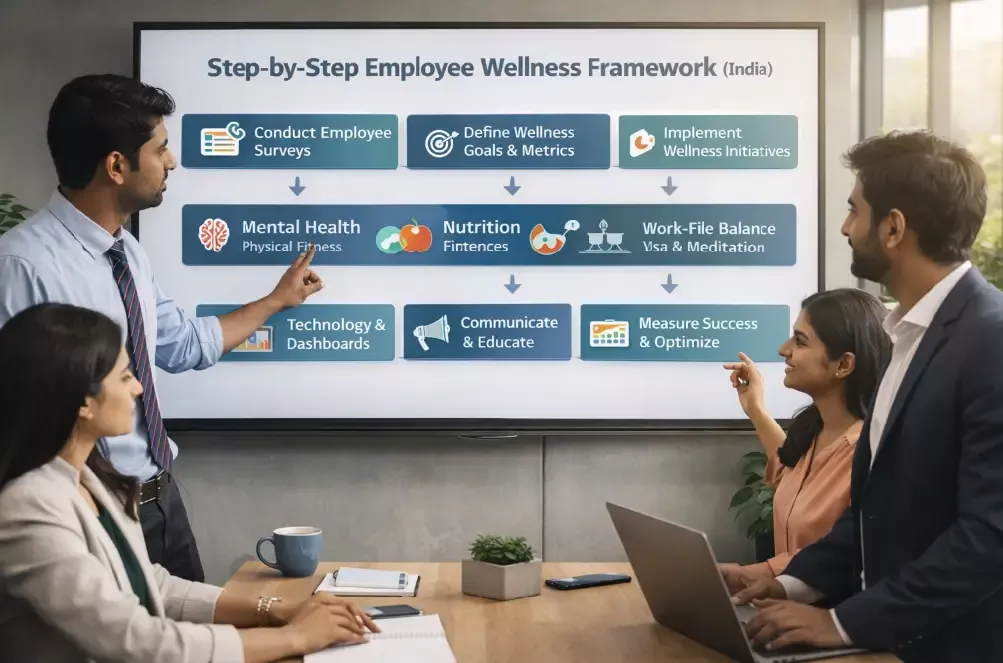
Let's understand the steps to build an effective wellness program.
Step 1: Conduct Employee Surveys
An organisation must assess employee needs and desires by conducting surveys and analysing health data to build an effective corporate wellness program.
Step 2: Define Wellness goals and metrics
The organisation should define the ultimate result expected via the wellness program. It can be anything, such as reducing absenteeism by 30% or raising engagement by 40%.
Step 3: Including well-being pillars
There are mainly four well-being pillars: physical, mental, nutrition, and work-life balance. Including all four in the program can give it a holistic approach.
Step 4: Embrace Indian practices
Introducing Indian practices such as meditation and yoga can foster familiarity.
Step 5: Employ Dashboards
Dashboards and HR predictive analytics assist by tracking engagement, evaluating key metrics, and monitoring employee progress.
Step 6: Communication and Education
A clear and concise communication of the program increases its effectiveness. Moreover, an annual meeting can create awareness and educate them on the organisation’s policies and initiatives.
Step 7: Measure Success and Optimise
The pivotal step is to measure the success against its objectives. To understand performance, a periodic review, along with the percentage of deviations, can be evaluated.
What Are Common Challenges in Implementing Wellness Programs in India?
The common challenges in implementing wellness programs are
- Budget constraint—Small and mid-sized firms find wellness programs too costly.
- Employee engagement—Employee participation may lag due to a lack of encouragement and incentives.
- Culture Barriers—Due to the stigma attached, employee engagement is slow in the initial stages of the program. In such cases, employers can implement a pilot program after considering cultural and sensitive elements.
How Can AI & Tech Enhance Wellness Programs?
AI and tech offer new capabilities, such as personalised wellness dashboards and benefits wallets where employees can choose activities they prefer.
Which company provides the best corporate wellness programs?
Pluxee offers wellness programs primarily through digital employee benefits like meal & multi-benefit passes, focusing on financial, physical, and personal well-being by providing tax-advantaged solutions for food, health, learning (L&D), and lifestyle needs, often integrated with a convenient app for managing expenses and accessing discounts (like Pluxee Pro) for better quality of life, supporting employees with healthy eating and stress management. They help employers boost satisfaction, retention, and productivity by addressing employee needs digitally.


Related articles