20 Best Indoor Team-Building Activities for Employees in 2026
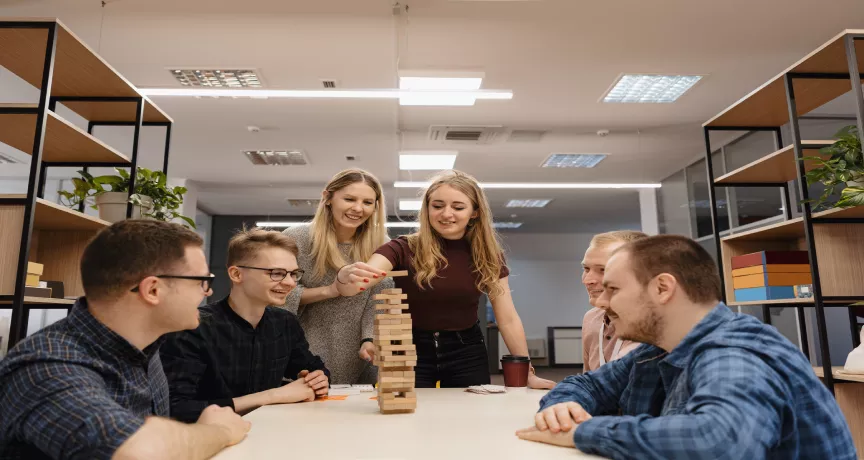
Great teams do not happen by accident. They grow through communication, trust, collaboration and shared experiences. But you do not need an expensive off-site or a full day away from work to help employees connect.
The right indoor team-building activities can turn a meeting room, office floor or shared workspace into an opportunity to strengthen relationships. From quick icebreakers and communication games to problem-solving challenges and team meals, these activities can work for different team sizes, budgets and schedules.
In this guide, I’ve selected 20 practical indoor team-building activities for employees that HR leaders, people managers and business leaders can use to create more engaging workplace experiences in 2026.
Key Takeaways & Figures
- This guide covers 20 indoor team-building activities for employees.
- Activities focus on communication, collaboration, problem-solving, trust, recognition and connection.
- Quick activities such as Two Truths and a Lie and Would You Rather? can take around 5 to 15 minutes.
- Longer activities such as escape-room challenges, Office Olympics and team cook-offs can take 30 minutes to 2 hours, depending on the format.
- Several activities require little or no specialist equipment.
- HR teams can select activities according to team size, time, employee preferences and the behaviour they want to strengthen.
- Inclusive team building should consider accessibility, dietary needs, cultural differences, language preferences and different employee comfort levels.
- Team building can be incorporated into meetings, onboarding, employee engagement initiatives and workplace celebrations.
What Are Indoor Team-Building Activities?
Indoor team-building activities are structured games, exercises and shared experiences that help employees improve communication, collaboration, trust and workplace relationships. They take place inside an office, meeting room or other indoor venue and can range from five-minute icebreakers to longer problem-solving challenges.
Unlike a large off-site event, indoor activities can often fit into the normal working day. HR teams can use them during team meetings, employee engagement programmes, onboarding sessions, celebrations or dedicated team-building events.
Some activities focus on fun and connection, while others develop specific workplace skills:
- Communication: Back-to-Back Drawing and Blind Drawing
- Collaboration: Paper Tower Challenge and Indoor Scavenger Hunt
- Problem-solving: Escape Room and Think Tank Challenge
- Recognition: Appreciation Circle and Memory Wall
- Team bonding: Human Bingo and Team Meal
- Energy and fun: Office Olympics and Minute to Win It
The key is to choose an activity with a clear purpose. If you want employees to communicate more effectively, select a communication challenge. If your priority is connection, choose an activity that gives colleagues opportunities to interact and learn more about one another.
Why Are Indoor Team-Building Activities Important for Employees?
Indoor team-building activities give employees structured opportunities to communicate, solve problems and connect outside their usual tasks. For HR and people managers, they can complement broader efforts to strengthen employee engagement, workplace relationships and team culture.
Improve Communication
Good teamwork starts with communication.
Activities such as Back-to-Back Drawing encourage employees to explain ideas clearly, listen carefully and check whether their message has been understood.
Instead of simply telling employees to communicate better, these exercises create practical situations where clear communication matters.
Strengthen Collaboration
Many workplace goals require employees to combine different skills, perspectives and responsibilities.
A Paper Tower Challenge, scavenger hunt or escape-room activity gives employees a shared objective. Participants need to divide responsibilities, exchange ideas and work towards the same outcome.
The activity may be a game, but the behaviours it encourages are relevant to everyday teamwork.
Build Trust Between Employees
Trust develops when colleagues have opportunities to rely on one another and interact beyond routine tasks.
Team-building exercises can create these opportunities in a low-pressure environment. Employees can contribute ideas, ask for help, make decisions together and discover how their colleagues approach challenges.
However, trust should never be forced. Avoid activities that require employees to disclose sensitive personal information or participate in situations that make them uncomfortable.
Support Employee Engagement
Team building works best when it forms part of a broader employee engagement approach rather than functioning as an isolated annual event.
Short activities during meetings, recognition exercises, shared celebrations and team experiences can create additional opportunities for employees to participate in workplace life.
For HR teams, this means moving beyond "Which game should we organise?" and asking:
"What kind of employee experience do we want this activity to create?"
Create Stronger Workplace Connections
Employees often spend most of their working day discussing deadlines, projects and operational priorities. That leaves limited space to learn about the people behind the job titles.
Human Bingo, Memory Wall and Team Meals can create opportunities for informal conversations and shared experiences.
This can be particularly useful when welcoming new employees, bringing departments together or helping teams reconnect after organisational changes.
Expert Insight: Start With the Outcome
In my experience, one of the easiest team-building mistakes is choosing an activity simply because it looks entertaining.
I recommend defining the outcome first. Ask whether you want to improve communication, encourage collaboration, recognise employees, welcome new team members or simply give people time to connect.
The best team-building activity is not necessarily the most elaborate one. It is the activity that fits your people, your purpose and your workplace.
20 Best Indoor Team-Building Activities for Employees
The best indoor team-building activities combine a clear purpose with simple participation. Here are 20 options you can adapt according to your team size, available time and employee engagement objectives.
1. Two Truths and a Lie
Best for: Icebreaking and new teams
Team size: 5 to 20 people
Time: 10 to 20 minutes
What you need: Nothing
How to play:
- Each employee prepares three statements about themselves.
- Two statements are true and one is false.
- The employee shares all three without revealing the lie.
- Colleagues vote on which statement they think is false.
- Reveal the answer and continue with the next participant.
Why it works: It gives colleagues an easy way to learn something new about one another. Keep topics light and personal disclosure optional.
2. Office Trivia
Best for: Team bonding and company knowledge
Team size: 6 to 50+ people
Time: 15 to 30 minutes
What you need: Questions and a digital quiz tool or answer sheets
Divide employees into teams and ask questions about general knowledge, workplace topics or popular culture. Award points for correct answers and add a tie-breaker when required.
Why it works: Trivia combines conversation, teamwork and friendly competition. Mix company-specific questions with broader topics so newer employees can participate equally.
3. Back-to-Back Drawing
Best for: Communication and active listening
Team size: 4 to 30 people
Time: 15 to 20 minutes
What you need: Images, paper and pens
Employees work in pairs. One person describes an image without showing it, while their partner attempts to draw it based solely on the verbal instructions.
Why it works: Employees quickly see how the same information can be interpreted differently, making this a practical communication exercise.
4. Paper Tower Challenge
Best for: Collaboration, creativity and problem-solving
Team size: 4 to 30 people
Time: 20 to 30 minutes
What you need: Paper and tape
Divide employees into teams and give each group the same materials. Challenge them to construct the tallest free-standing tower within the time limit.
Why it works: Teams need to plan, experiment, allocate responsibilities and adapt when an idea does not work.
5. Indoor Scavenger Hunt
Best for: Collaboration and workplace energy
Team size: 6 to 50+ people
Time: 30 to 60 minutes
What you need: Clues and challenges
Create workplace-friendly clues and divide employees into teams. Participants work together to solve clues, find objects or complete tasks within a set time.
Why it works: Scavenger hunts combine problem-solving, communication and movement while encouraging employees to collaborate.
6. Escape Room Challenge
Best for: Problem-solving and teamwork
Team size: 4 to 12 people per group
Time: 45 to 90 minutes
What you need: Escape-room venue or office puzzle setup
Give teams a scenario and a series of interconnected puzzles to solve before time runs out.
Why it works: Employees need to share information, delegate tasks, solve problems and make decisions under time pressure.
7. Minute to Win It
Best for: Energy and larger groups
Team size: 10 to 50+ people
Time: 20 to 45 minutes
What you need: Depends on the challenges
Prepare simple tasks that employees must complete within 60 seconds. Divide employees into teams and award points for each successful challenge.
Why it works: Short rounds keep energy high and give multiple employees opportunities to participate.
8. Charades
Best for: Communication and bonding
Team size: 6 to 30 people
Time: 20 to 30 minutes
What you need: Words or phrases
One participant acts out a word or phrase without speaking while teammates attempt to identify it within the time limit.
Why it works: Charades encourages non-verbal communication while creating a relaxed, enjoyable team experience.
9. Human Bingo
Best for: Networking and new employees
Team size: 10 to 50+ people
Time: 15 to 30 minutes
What you need: Bingo cards
Create cards containing workplace-appropriate statements. Employees talk to colleagues to find someone matching each statement and add their name to the corresponding square.
Why it works: Human Bingo gives employees a reason to interact with colleagues beyond their immediate teams.
10. Memory Wall
Best for: Recognition and team connection
Team size: 5 to 50+ people
Time: 20 to 30 minutes
What you need: Sticky notes, cards and a board
Ask employees to write down a positive workplace memory, milestone or shared achievement. Add them to a wall and invite employees to discuss selected moments.
Why it works: It encourages teams to reflect on shared achievements and positive experiences.
11. Office Olympics
Best for: Fun, collaboration and larger teams
Team size: 10 to 50+ people
Time: 30 to 60 minutes
What you need: Simple office supplies
Create several safe, office-friendly challenges and divide employees into teams. Rotate groups through the activities and award points.
Why it works: Office Olympics combines friendly competition with teamwork. Include puzzles and creative challenges so physical ability is not the main determinant of success.
12. Blind Drawing
Best for: Listening and communication
Team size: 4 to 30 people
Time: 15 to 20 minutes
What you need: Paper, pens and prompts
One employee describes a word, shape or image while their partner draws it without seeing the original.
Why it works: The exercise demonstrates the difference between what one person intends to communicate and what another person understands.
13. Would You Rather?
Best for: Quick icebreakers
Team size: 4 to 30+ people
Time: 5 to 15 minutes
What you need: Prepared questions
Ask employees light "Would you rather?" questions and invite them to choose an answer. Participants can explain their choices if they wish.
Why it works: It is easy to organise, requires almost no resources and can fit naturally into a team meeting.
14. Desk Item Challenge
Best for: Creativity and collaboration
Team size: 6 to 30 people
Time: 15 to 30 minutes
What you need: Everyday office objects
Give teams ordinary desk items and ask them to create an invention, solve a problem or build a structure.
Why it works: Employees need to combine ideas and find creative ways to use limited resources.
15. Team Cook-Off or Food Challenge
Best for: Collaboration and social connection
Team size: 6 to 30 people
Time: 60 to 120 minutes
What you need: Ingredients, utensils and a suitable space
Divide employees into teams and give them a food-related challenge. Teams prepare and present their creation within the available time.
Why it works: Food creates an informal environment for collaboration and conversation. Account for allergies, dietary requirements, religious practices and individual preferences before planning the activity.
16. Bollywood Dumb Charades
Best for: Fun and informal bonding
Team size: 6 to 30 people
Time: 20 to 40 minutes
What you need: Film titles
Participants act out Bollywood movie titles without speaking while their teammates guess the answer.
Why it works: The format can feel familiar and engaging for many Indian teams. For culturally diverse workplaces, broaden the categories to regional cinema, international films or other entertainment topics.
17. Team Timeline
Best for: Reflection, onboarding and team identity
Team size: 5 to 30 people
Time: 30 to 45 minutes
What you need: Large paper, cards or a whiteboard
Create a timeline and ask employees to add important team milestones, achievements and memorable experiences.
Why it works: The activity helps newer employees understand the team's journey while giving longer-serving employees opportunities to share context.
18. Appreciation Circle
Best for: Employee recognition and positive team culture
Team size: 4 to 20 people
Time: 15 to 30 minutes
What you need: Nothing
Ask employees to recognise a colleague for a specific contribution, behaviour or act of support.
Why it works: Specific appreciation can highlight contributions and positive workplace behaviours that may otherwise go unnoticed. Participation should remain voluntary.
19. Think Tank Challenge
Best for: Problem-solving and innovation
Team size: 6 to 30 people
Time: 30 to 60 minutes
What you need: Problem statement and presentation materials
Give teams the same fictional or workplace challenge. Ask them to develop a solution within a time limit and present their recommendation.
Why it works: The activity combines analysis, creativity, communication and collaborative decision-making.
20. Team Meal
Best for: Informal connection
Team size: Any team size
Time: 45 to 90 minutes
What you need: An inclusive meal arrangement
Organise a shared meal where employees can talk outside routine meetings and project discussions. Avoid turning the entire meal into another work meeting.
Why it works: Team building does not always need a competitive activity. Shared meals can create space for relaxed conversations and workplace connection.
How Do You Choose the Right Indoor Team-Building Activity?
Choose your activity based on the outcome you want, team size, available time, budget, employee preferences and accessibility requirements. Starting with the objective makes it easier to select an activity that delivers meaningful value.
|
Your goal |
Recommended activities |
Typical time |
|
Break the ice |
Two Truths and a Lie, Human Bingo |
10 to 30 minutes |
|
Improve communication |
Back-to-Back Drawing, Blind Drawing |
15 to 20 minutes |
|
Strengthen collaboration |
Paper Tower, Scavenger Hunt |
20 to 60 minutes |
|
Develop problem-solving |
Escape Room, Think Tank |
30 to 90 minutes |
|
Encourage creativity |
Desk Item Challenge, Cook-Off |
15 to 120 minutes |
|
Increase energy |
Minute to Win It, Office Olympics |
20 to 60 minutes |
|
Encourage recognition |
Appreciation Circle, Memory Wall |
15 to 30 minutes |
|
Build connections |
Team Meal, Team Timeline |
30 to 90 minutes |
Start With a Clear Objective
Ask one question before choosing an activity:
What do I want employees to get from this experience?
Your objective could include:
- Welcoming new employees
- Improving communication
- Encouraging cross-functional collaboration
- Developing problem-solving skills
- Recognising employee contributions
- Reconnecting teams
- Celebrating achievements
- Creating an enjoyable break from routine
Match the Activity to Your Available Time
You do not need an entire afternoon.
For 5 to 15 minutes, consider Would You Rather? or Two Truths and a Lie.
For 15 to 45 minutes, consider Human Bingo, Blind Drawing, Paper Tower or Memory Wall.
For 45 minutes or longer, consider an Escape Room, Indoor Scavenger Hunt, Office Olympics, Team Cook-Off or Team Meal.
Consider Your Budget
Effective team building does not require a large event budget.
Two Truths and a Lie, Would You Rather? and an Appreciation Circle require almost no equipment. Paper Tower and Blind Drawing need only basic stationery.
External escape rooms, catered meals and cook-offs may require additional spending.
I recommend deciding the objective first and the budget second. A simple activity with a clear purpose can be more useful than an expensive experience that employees do not enjoy.
Ask Employees What They Prefer
HR teams do not have to guess.
Use a quick employee poll to understand whether your team prefers:
- Competitive games
- Creative challenges
- Food experiences
- Problem-solving activities
- Social gatherings
- Recognition activities
- Low-pressure conversation games
Employee input can also help you identify accessibility, scheduling and cultural considerations early.
How Can HR Make Team-Building Activities More Inclusive?
Inclusive team building gives employees meaningful ways to participate without expecting everyone to participate in exactly the same way. Consider physical accessibility, dietary requirements, cultural differences, language, personality types and individual comfort from the planning stage.
Consider Physical Accessibility
Do not assume every employee can comfortably run, stand for long periods or perform physically demanding tasks.
Instead:
- Choose accessible venues
- Provide seated participation options
- Offer alternative roles
- Combine physical and non-physical challenges
- Check accessibility needs in advance
Respect Different Personality Types
Some employees enjoy performing in front of colleagues. Others prefer puzzles, small-group conversations or creative challenges.
Give employees different ways to contribute.
In a Think Tank Challenge, for example, one employee might generate ideas, another might organise the solution and another might present it.
Participation should create connection, not pressure.
Make Food Activities Inclusive
Before organising team meals or food challenges, consider:
- Allergies
- Vegetarian or vegan preferences
- Religious dietary requirements
- Other dietary restrictions
- Non-alcoholic beverage requirements
Suitable choices should be planned from the beginning.
Be Sensitive to Cultural and Language Differences
Avoid assuming that every employee shares the same cultural references.
Bollywood Dumb Charades, for example, may work well for some teams. For a diverse workforce, you can include regional cinema, international films and other entertainment categories.
Avoid Forced Personal Disclosure
Do not build icebreakers around sensitive personal information.
Avoid prompts involving:
- Health
- Finances
- Religion
- Relationships
- Family planning
- Political beliefs
- Deeply personal experiences
Keep questions light, optional and appropriate for the workplace.
Include Hybrid Employees
For hybrid teams, choose activities that allow remote employees to participate meaningfully.
Options include:
- Online trivia
- Digital Human Bingo
- Would You Rather?
- Virtual drawing challenges
- Appreciation activities
- Collaborative puzzles
- Team quizzes
The format may change, but the objective remains the same: give employees an opportunity to contribute and connect.
Expert Insight: Do Not Confuse Participation With Engagement
In my experience, a room full of people taking part does not automatically mean an activity is engaging.
I recommend looking beyond attendance. Notice whether employees feel comfortable contributing, whether different personalities have opportunities to participate and whether the activity supports the outcome you originally defined.
The best activities leave employees feeling more connected to their colleagues, not exhausted by compulsory fun.
How Often Should Companies Organise Team-Building Activities?
Team building can work best as a regular part of the employee experience rather than a once-a-year event. Companies can combine short activities during meetings with monthly or quarterly initiatives and occasional larger team experiences.
A practical schedule could include:
- Weekly or fortnightly: 5 to 15-minute icebreakers or appreciation activities
- Monthly: Team games, quizzes or creative challenges
- Quarterly: Longer collaborative or cross-functional activities
- During onboarding: Connection activities for new employees
- Around milestones: Team meals, recognition and celebrations
- Annually: Larger team experiences or company-wide events
There is no universal schedule. Choose a cadence that works for your employees and does not make team building feel like another obligation.
Make Team Building Part of Employee Engagement
Consider the moments that shape the employee experience.
Joining a team, completing a major project, receiving recognition or celebrating a milestone can all become opportunities for meaningful connection.
Instead of asking, "When should we organise another team-building event?", consider asking:
"Where could a shared experience make this employee moment more meaningful?"
Ask for Feedback
After an activity, ask employees:
- Did you enjoy participating?
- Did you feel comfortable?
- What did you like?
- What would you change?
- Would you participate again?
- What should we try next?
Use that feedback to create future experiences around what employees actually value.
Build Stronger Teams Through Everyday Connections
You do not need an elaborate off-site event to bring employees together.
From a 10-minute icebreaker to a 90-minute collaborative challenge, indoor team-building activities can create opportunities for employees to communicate, solve problems, recognise one another and strengthen workplace relationships.
The most effective approach starts with your people. Understand what employees enjoy, choose activities with a clear purpose and make sure everyone has a comfortable way to participate.
Most importantly, do not treat team building as a box to tick once a year. Small, thoughtful experiences throughout the employee journey can help make connection part of everyday workplace culture.
At Pluxee, we believe meaningful employee experiences are built through everyday moments that help people feel connected, recognised and valued. By combining thoughtful team experiences with a broader employee engagement approach, organisations can create more opportunities for employees to enjoy what really matters at work.
Because stronger workplace connections can start with something as simple as bringing people together.
Frequently Asked Questions
1. What Are the Best Indoor Team-Building Activities for Employees?
The best indoor team-building activities depend on your objective. Popular options include Two Truths and a Lie, Office Trivia, Human Bingo, Paper Tower Challenge, Indoor Scavenger Hunt, Escape Room Challenge, Office Olympics, Appreciation Circle and Team Meals.
Choose communication games for listening skills, collaborative challenges for teamwork and recognition activities for employee connection.
2. What Are Some 5-Minute Team-Building Activities?
Quick team-building activities include Would You Rather?, rapid-fire trivia, short charades, appreciation prompts and icebreaker questions.
These activities require little preparation and can fit into the beginning or end of a team meeting.
3. What Team-Building Activities Require No Equipment?
Indoor team-building activities requiring little or no equipment include:
- Two Truths and a Lie
- Would You Rather?
- Charades
- Appreciation Circle
- Verbal trivia
- Team storytelling
- Quick icebreaker questions
These are useful when you need a low-cost team-building activity that can be organised quickly.
4. Which Team-Building Activities Improve Communication and Trust?
Back-to-Back Drawing, Blind Drawing, Think Tank Challenges, Escape Room Challenges and collaborative problem-solving games can give employees opportunities to practise communication and teamwork.
Appreciation Circles, Memory Walls and Team Meals can support connection by giving colleagues opportunities to recognise contributions and interact outside routine tasks.